
Optimizing Academic Scheduling for a Better Cornell Experience.
Who We Are
The Cornell Scheduling Team, founded by Professor David Shmoys, began with a vision to address the complex challenges of academic scheduling at Cornell University. Recognizing the impact that efficient, conflict-free schedules can have on students’ academic success and well-being, we embarked on a mission to bring advanced mathematical modeling and optimization techniques to the process.
What started as a small research project has since evolved into a collaborative effort that leverages cutting-edge algorithms and real-world data to create scheduling solutions tailored to Cornell’s unique academic demands.
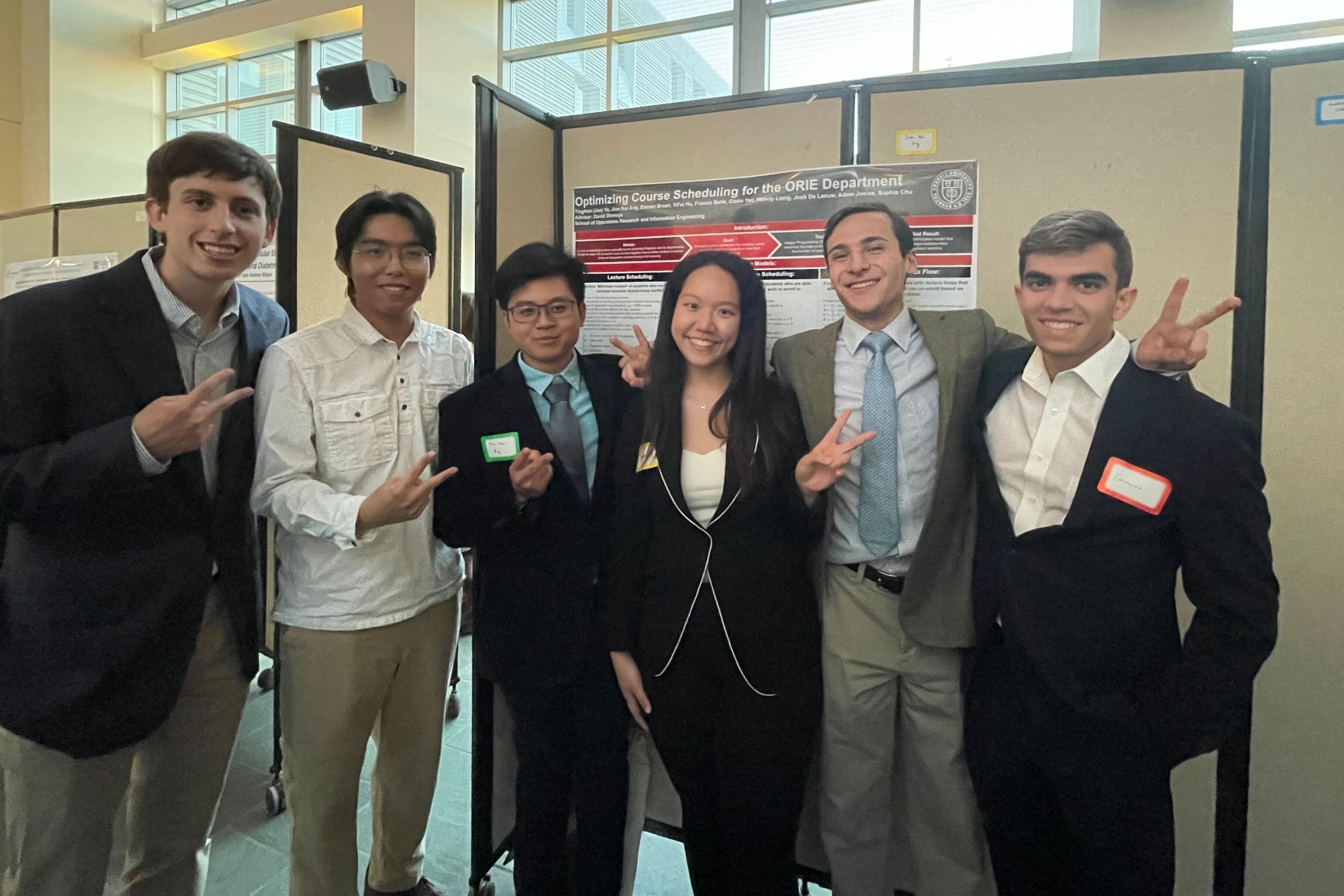

What We Do
Our team optimizes exam and course schedules by utilizing optimization framework based on mixed-integer programming (MIP) that consider course demands and student co-enrollments.
We create balanced, fair schedules with zero conflicts. Our work not only streamlines scheduling logistics but also has a tangible impact on students and faculty by enhancing academic efficiency and reducing stress.
The Cornell Scheduling Team continues to refine its approach to create even more resilient, adaptable schedules that suit both the needs of students and faculty at Cornell.
Our Approach
We employ a MIP-based optimization framework to automate final exam scheduling at Cornell University. Our models address not only direct exam conflicts and back-to-back exams, but also more complex metrics.
Our schedules are tailored to the specific challenges faced by Cornell University. We aim to balance student and faculty comfort during finals week by providing trade-offs across multiple conflict levels.
Our Impact
By applying this framework, we have successfully scheduled final exams for all Cornell University students over five consecutive semesters, impacting over 100,000 students.
The power of our framework lies its flexibility and adaptability to each institutions’ needs. Our framework enables the creation of customized schedules that balance different institutional preferences. We optimize the trade-off between improved student outcomes and other priorities.
Our Vision for the Future
Releasing final exam schedules earlier in the semester would allow students and faculty to better prepare for breaks. To achieve this, we are exploring a machine learning approach that uses pre-enrollment and historical enrollment data to predict post-Add/Drop enrollment.
We also aim to better incorporate student preferences into the scheduling model. Modeling these preferences allows us to create a more student-centered schedule, improving the overall exam experience and reducing stress around finals.
 Cornell Scheduling Team